
Functional Features
Version 3.0 of the service software features the following:
● It connects to devices through multiple communication methods (TCP, UDP, serial port, Type A receiver) and supports the coexistence of multiple device protocols.
● The device driver adopts a plug-in structure, enabling dynamic expansion.
● It allows users to perform derivative calculations on collected raw data (supporting derivatives between devices).
● It is completely separated from the application system and can be deployed and run independently.
● It comes with a built-in database that requires no separate deployment, ensuring data storage for more than 10 years.
● Remote maintenance of the system is realized through the maintenance client, and the system operates uninterruptedly during maintenance.
● A dedicated plug-in server is provided for function expansion to ensure the stability of the communication system.
● A development kit is available to facilitate integration with other systems.
Design of Derivative Functions for Communication Service Software:
In the practical project applications of Welletronics Communication Service Software, it is often encountered that after the data reported by acquisition terminals is parsed, further derivative calculations of the data are still required to meet the needs of actual projects.
For example, based on the water level value collected by a measuring station, combined with the "wellhead elevation" and "water level gauge deployment depth" of the station, values such as water level elevation and water level depth can be calculated.
The derivative requirements in projects vary greatly. If customization is made according to project conditions every time, it will inevitably increase R&D costs. Therefore, the communication service software uses "expressions" to describe the generation algorithms of such data.
This not only reduces the development costs of subsequent engineering projects, but also enables engineering personnel and system administrators to participate in project implementation.
● Processing Flow in Communication Service Software
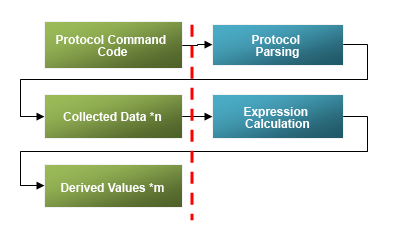
The real-time data of the station consists of collected quantities and derived quantities, and the derived quantities are generated by the expression operation module.
● Implementation of Expression Operations
The model of expression operations is shown in the following figure:
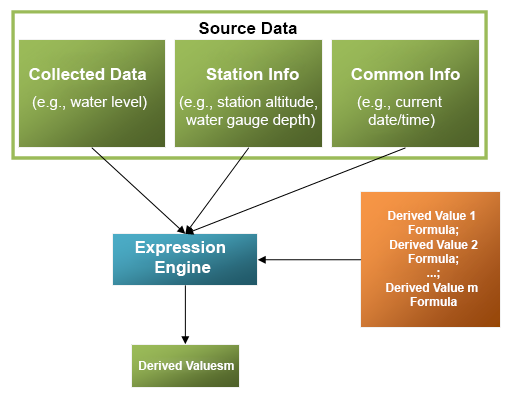
The source data will be substituted into the expression to participate in the operation.
To make the expression have a wider range of adaptability, two types of data, namely station information and common information, are also introduced into the source data. Each derived quantity corresponds to an expression, which describes the operation algorithm and supports both arithmetic and logical operations.
The "Expression operation engine" is the executor of an expression, which acquires the derived final result by substituting source data into the expression to perform operations.







.png)
.png)